
Meet the New Boss - February 2026
John Dashe takes up the challenge in Timor
“I believe that when people have an occupation that allows them to provide for their families, the social dimension of human nature will emerge instinctively and lead people to help and organise others less privileged”
Xanana Gusmao, former member of FRETILIN (Frente Revolucionária do Timor-Leste Independente), Timor-Leste’s inaugural President and now the current Prime Minister.
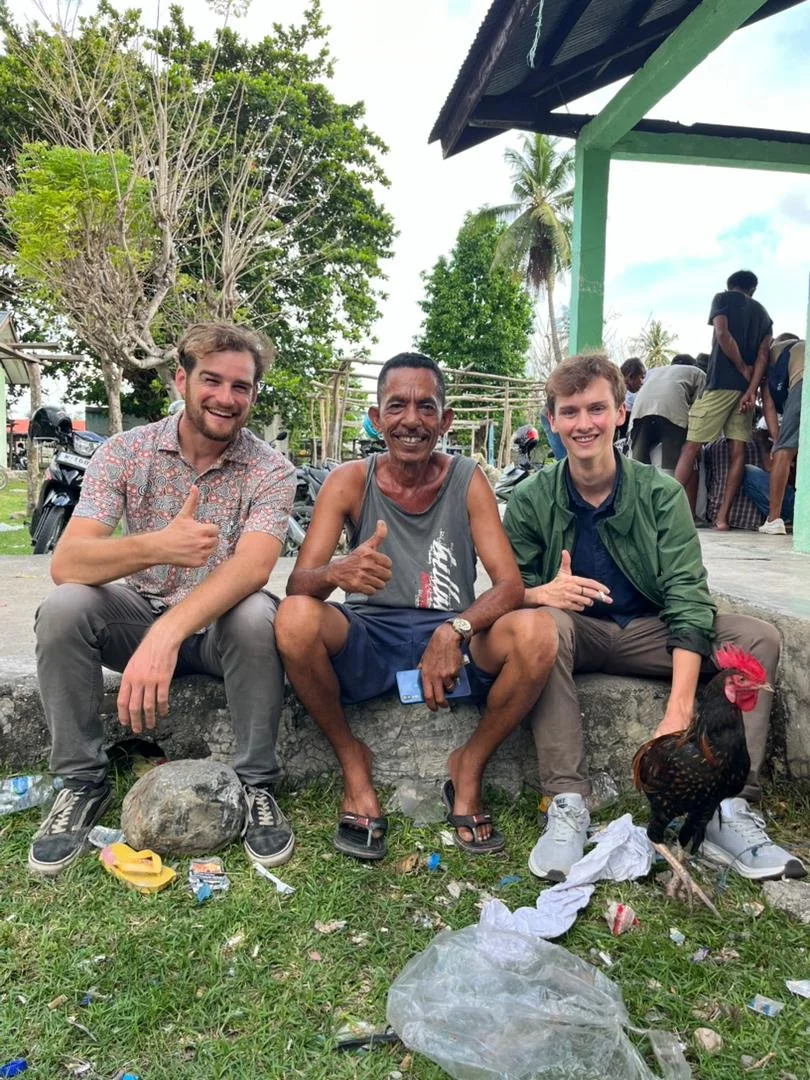
On the left: John Dashe (right) and outgoing Abundant Water Timor-Leste former program supervisor Chris Draper (left), meeting with potential customers and vendors at a "manu-futu" (cockfighting) event in Salele, Cova Lima municipality, Timor Leste
In Dili, the capital of Timor-Leste, a city of over 300,000 people, the monsoon season is in full swing. In the next few months some areas will be drenched by tropical downpours that may dump as much as 300 mm of rain in a single intense storm. And yet despite the heavy rain most Timorese will struggle to source reliable supplies of fresh, clean water.
A lack of plumbed toilets in the city means that raw sewage seeps through the porous limestone soils into the ground water and torrential rain washes away what remains into rivers and streams. It is believed that half of the children in throughout Timor become sick from repeated infections due to waterborne disease. In the recent past a potentially game-changing promise by USAID to help finance a water treatment plant, part of a substantial package for Dili, has been abruptly abandoned. The knock-on effects of USAID’s withdrawal from Timor have contributed to other NGOs reducing their activities. Some others have left the country altogether.
The President of Timor-Leste and a Nobel Peace Prize laureate, José Ramos-Horta, said of USAID’s withdrawal that the action is “beyond comprehension […] unprecedented between friends.”
Which makes Abundant Water’s volunteer led mission in Timor even more important.
Meet the New Boss
John Dashe is AW’s new Program Supervisor in Timor. Originally from Boston, Massachusetts, he came to Timor in February 2023 as part of the US State Department’s Fullbright Program. He’s been in Dili ever since. He believes that Abundant Water is different from other, more foreign aid dependent NGOs because of its volunteer base and its business model.
“Any company can sell a water filter, right? But what sets Abundant Water apart is the social enterprise model.”
“In Timor-Leste, when we first arrived in 2019 and in those early years of operation, [the filter] was really a new product. So, they were kind of flying off the shelves. Now, there are more competitors. These kinds of filters are now sold in a lot of different shops, so anyone can buy them, but the sustainability component is what's missing. Because when people buy it from a shop, there's no service, there's no information about how to maintain the product or when to replace the internal parts. They don't even sell the internal parts, just sell the filter itself. So, when it breaks down or when the filter gets dirty, it just gets thrown away, which is not sustainable at all.”
“That's what makes Abundant Water different. We're really trying to focus in on our sales, especially with our vendors, teaching them the importance of developing a long-term customer relationship, rather than just a one-time sale. It’s about selling [filters] and replacement parts year after year so that [customers] can continue using the filter for a long time. Not only is it environmentally sustainable and providing longer-term benefits for the customer, but also for the vendors providing them with a sustainable long-term income source, which is the social business goal of Abundant Water.”
“Another priority is improving our vendor network, helping [vendors] develop their micro-businesses so that they're able to reinvest and expand. That's the thing that really sets us apart.”

John delivering a filter to the director of Avo Ana Irena O. de Almeida preschool in Metinaro.
The Consumer Challenge
One of Abundant Water’s goals is to promote environmental sustainability, but the consumer culture developing in Timor over recent years is turning into a real challenge.
“I think in Timor-Leste, especially now, the market has really been flooded by cheap household goods. And I would say it's a big throwaway culture. You buy a cheap product and then when it breaks, you just throw it away and buy a new one, even if it's something that could be repaired and maintained. We're trying to change that mindset a little bit.”
Changing the way people think is a significant challenge in any community, but one that John believes can be addressed.
“If the customers receive good service, follow-up and attention from the vendors, I think they'll start to appreciate the benefit of it. If they get service from a vendor and they can buy a replacement ceramic filter every year instead of buying an entire new water filter apparatus, that's a benefit for them. Because it will result in savings for their household.”
The key to success for Abundant Water is to recruit local vendors to supply local people. However, building trust and developing the skills required is an ongoing process.
“At our last vendor meeting, we were discussing how in the US and in Australia a lot of companies now are trying to retain customers through a subscription model. That's really the kind of system that we want to show [vendors] that they can benefit from if they maintain their customer relationships.”
John sees that the real challenge for new vendors is often the first step. Breaking the ice and making that initial sale can be intimidating, no matter how motivated someone is. But Timor’s unique culture, grounded in relationships and community, offers rich opportunities for those willing to engage locally.
“I'll speak from my experience in the US. We don't really take too kindly to solicitation, such as door-to-door sales. I think Timor is a bit different. It's a more communitarian culture and everyone knows everyone in their neighbourhood. Neighbours and relatives wander by unannounced. So, I don't think that's as much of a barrier. It might be unexpected, but I don't think they'll be annoyed that we show up. But a lot of times also we'll call ahead of time and see who's in the neighbourhood when we're doing a field visit. Sometimes if we just know a customer lives in an area, we'll stop by. I think they do appreciate the attention, especially if we visit a customer who hasn't been attended to by the vendor that sold them their filter originally. I think they appreciate us coming by and showing them how to clean the filter, how often to replace a part, and so they continue using it for a long time, save some money.”
Clean Water for Schools
An adequate supply of clean drinking water in classrooms has a huge beneficial effect on a student’s health and well-being. As Chris Draper, John’s predecessor noted, teachers notice increased levels of attendance, there is a significant drop off in sickness and parents talk about their kids no longer getting diarrhoea.
For John, offering a viable clean water solution to schools is a key goal.
“This week, we're going to really be focusing on schools. We've already done the scoping for our existing schools. We've talked to them, we've been meeting with them and visiting them, talking about the upcoming school year. We've already got a list of schools that have indicated interest in getting filters or buying replacement parts for the filters they’re already using.”
“We will continue cultivating our relationships with people within the [Education] Ministry, at the national, municipal and local level. Having those relationships can really open a lot of doors for us to continue integrating our filters into schools. We're really trying now to get new schools and bring [them] into the fold, especially by purchasing filters with the funding schools receive through the government’s school feeding program. When schools purchase, at least in part, the filters themselves, they have a sense of ownership. This is important for us, especially in [early 2026] as the new school year starts.”
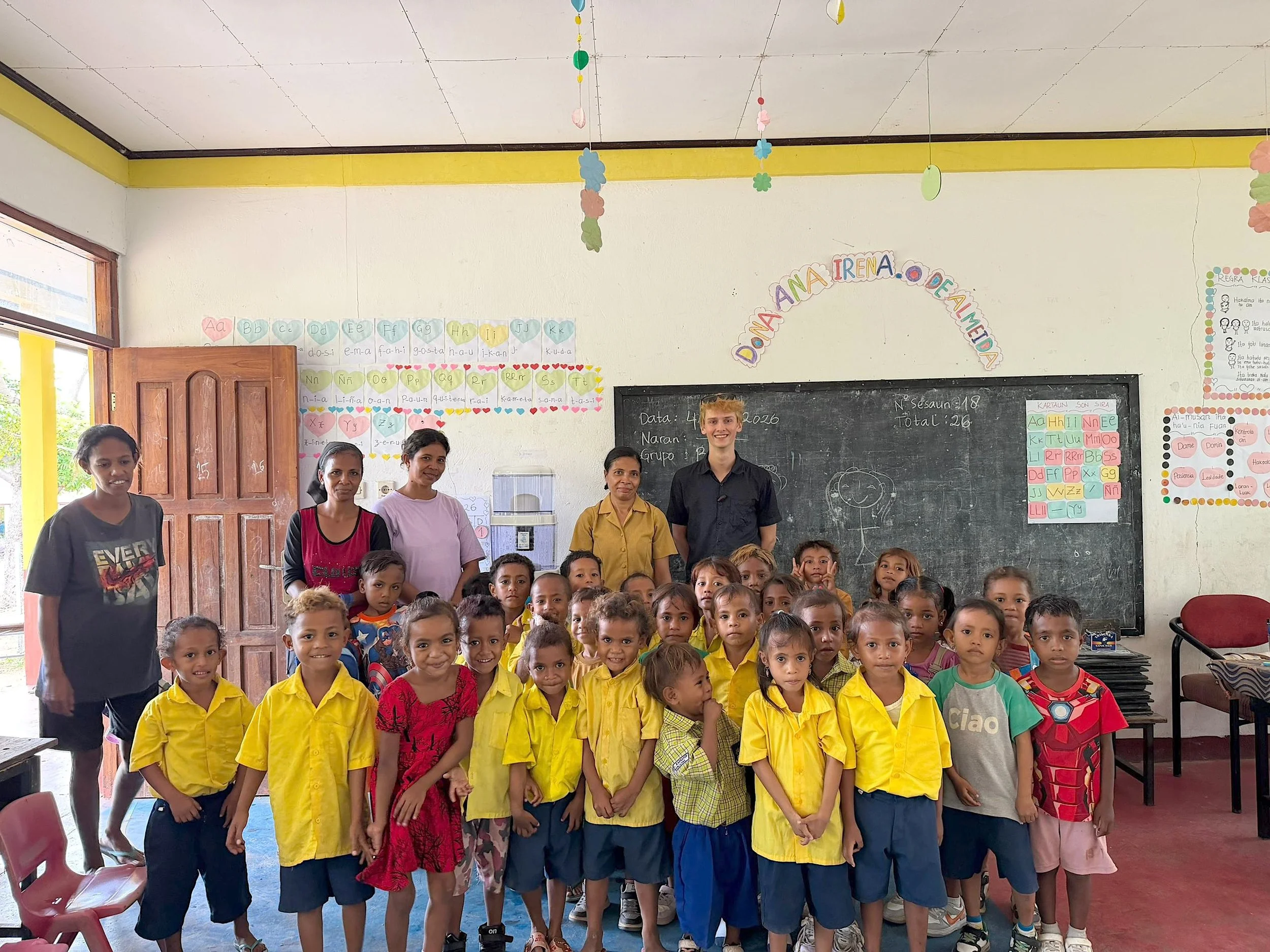
John with students and teachers at Avo Ana Irena O. de Almeida preschool in Metinaro after delivering filters provided by Abundant Water through support from the Denise Lee Holehouse Memorial Foundation.
Scooting
Abundant Water has directly donated hundreds of filters to schools across the country and will continue to do so. But getting to those schools in regional and remote areas is something John still has some work to do.
“I’ve been riding a scooter the whole time I’ve been here. There are roads in parts of rural Timor-Leste are really in poor condition and with just a simple scooter it's sometimes it's too difficult. Having a real motorbike makes it easier. That's another priority for me; learning how to ride a motorbike safely. That’s a must-have.. to learn how to ride and be able to use the bike for field visits.
Funding
Dashe has set himself some ambitious targets – more filters in more schools, increased vendor training, rising sales, developing partnerships and, critically looking for long-term funding opportunities.
“You know, three, four years ago, there was a lot more funding going around from USAID and other sources. [But now] we will have to be more adaptive and put a lot of effort into searching out opportunities and developing relationships with people here in Timor. Obtaining ongoing, multi-year funding is really the goal. [But] it's a bigger challenge now than it was in the past.”
Despite the withdrawal of USAID from Timor and the corresponding effects on other NGO’s Abundant Waters mission is unchanged: to deliver health and hygiene benefits by using the power of social business to design and develop sustainable, scalable clean drinking water projects.
But there’s no doubt achieving that mission just got a little bit harder. The international environment, as Canadian Prime Minister Mark Carney recently noted at Davos, is “in the midst of a rupture, not a transition”. In his speech Carney said investments are shifting, old policies are being abandoned. The previous ways of working and the opportunities they used to offer are being upended.
For Abundant Water it means having to adapt to the new reality. But, to be fair, it has done it all before.
Abundant Water, an Australian volunteer-led organisation, is taking action, now. Our work is already making a tangible difference in Timor-Leste, the Philippines, and Laos. But we need your help to go further, faster. Even the smallest contribution can mean clean water, better health, and renewed hope for families in need.
Act now - Because clean water can’t wait